Silence Did Not Signal Consent
How silence moves through families, institutions, and systems — not as absence, but as architecture.
Christopher H. Conn
It moves through families, faith, schools, courts, and the unspoken codes of the South — often without ever asking permission. These essays examine the structures that manufacture consent, counterfeit identity, and the slow work of reclaiming what was taken.
The first time you silence yourself to preserve belonging, you do not know you are making a trade.
Silence had not protected me. It had cooperated.
My crime was not a deviation from my training. It was its completion.
The body keeps what the mind cannot afford to hold. And the body does not care whether you have a diagnosis that is supposed to erase it.
Failure in families like mine is not an event. It is an identity crisis.
Consent does not exist in a vacuum. It is formed by hierarchy and capacity.
This is what happens when you choose out loud.
Training for this had come from every room I ever occupied.
She came home different. So did her youngest child. Without knowing it yet.
Forty years were spent learning to find my words. She is beginning to lose hers.
The chair absorbed me, upholstered in something slick and cool that stuck to the backs of my thighs. My feet did not reach the floor—one swing of them, instinctive, before catching myself. He paused, then added the incentive. “If you can stay unnoticed, invisible, we'll go to 7-Eleven afterward. You can get a Slurpee. You can choose one candy.”
The paper held its shape for a moment—a small, bright thing sitting atop the current, flames curling the edges inward. Then the fire reached the center, and the letter opened as it burned, the way a fist opens when the body finally exhales. The current took what was left.
A child alone on Lake Michigan with a tiller and a mainsheet—the tiller polished smooth from a thousand hands, the mainsheet rope burning across small palms when the wind caught wrong—and the water stretched enormous, and no one watched. The lake gave off the scent of clean rock and distance.
Her hand lifted slightly, gesturing upward—exactly where the lights would have been. Not in this room. In that one. Forty-five years ago. Her body was pointing at a ceiling that no longer exists, in a building she could not have found on a map, and the gesture carried the precision of someone who had never left.
He made me a dirty martini—olive brine and cold vodka, the salt crisp on my tongue, the glass so chilled it pulled the warmth itself from my fingers. Reward framed as ritual. The restaurant had emptied. The air still held the residue of the evening—garlic, red wine, the burnt-sugar note of something reduced too far.
A mattress that held the warmth of whoever had been there before me. A cell that smelled of concrete dust and the sour residue of other men's sleep. The body adjusts to confinement faster than you expect. What it does not adjust to is the total irrelevance of every story you have ever told about yourself.
A ticker tape machine clicked and buzzed softly, spitting out long ribbons of narrow paper—waxy and faintly warm from the machine, smelling of ink and ozone. Commodity codes. Contract months. The paper pooled onto the floor in soft coils, like something alive that never stopped producing itself.
Memory holds the location precisely. Hidden at the top of the stairs. Lying on the deep pile of the shag red carpet, hands braced around the banister. Close enough to hear everything. Far enough to be forgotten. The room changed before anyone spoke. The air tightened.
A garage bedroom. The air pressed stale and close—drywall dust, laundry detergent, the slight sweetness of a plug-in air freshener masking something underneath. A room that existed at the margins of a life already in dissolution.
I rode down Beach Drive, cool air drifting off Little Traverse Bay, the smell of fir and lake water moving in waves with the wind. The harbor announced itself gradually—masts rising above rooftops first, thin lines against the sky, halyards clinking against aluminum poles.
Six frameworks for understanding how authority operates — and what it costs.
How silence moves through families, institutions, and systems — not as absence, but as architecture.
A Southern coming-of-age. Nashville, family systems, and the machinery that manufactures consent through displacement.
A mother's Alzheimer's, postpartum depression, and what silence deposits in the body when language fails.
Kenneth Frazier, federal prison, and the collapse of narrative systems that were never yours to begin with.
The counterfeiter is the most honest product of a system built on counterfeiting.
How The Sun and Guernica teach through what they withhold — and what editorial restraint reveals about power.
A three-essay reading path through the central arguments.
The comprehensive examination of how silence operates as architecture — through families, institutions, and systems.
Nashville, displacement, and the machinery that manufactures consent through family systems.
What silence deposits in the body when language fails. The personal made structural.

A queer Southern memoir of institutional survival and spiritual reclamation.
From evangelical Nashville to federal prison to rebuilding behavioral-health systems in Colorado, this coming-of-age memoir traces the individuation of a self that institutions spent decades counterfeiting — and the slow work of integration when the persona finally collapses.
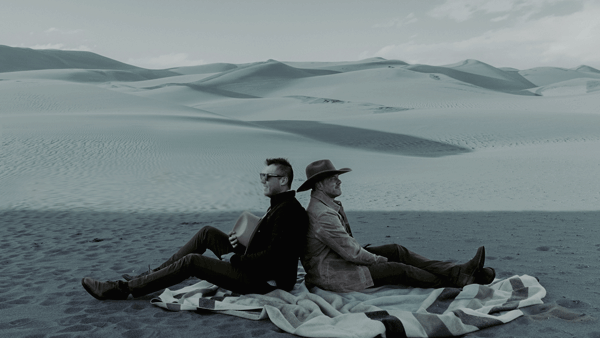
Christopher H. Conn is a queer Southern writer whose work examines power, consent, and institutional failure through memoir, Jungian psychology, and systems analysis. He founded Fidelity Behavioral Health, a closed-continuum program in Colorado for justice-involved and unhoused individuals that was studied by a SAMHSA workgroup.
His memoir, Consent Without Language, is a coming-of-age that traces a life lived across evangelical Nashville, the federal justice system, and the behavioral-health infrastructure — examining how institutions counterfeit identity, how the persona collapses, and what spiritual reclamation actually requires.
Full Biography